Property Management
Technology
Product News

Selecting a condo management platform shapes how your team communicates, collects payments, and serves residents every single day. Portfolio managers face growing pressure to modernize operations without adding headcount or disrupting existing workflows across buildings. Making a well-informed choice now can save your team hundreds of hours and reduce operational friction across your entire portfolio.
Condo boards, property managers, and operations leaders each bring different priorities to the evaluation process. A strong platform serves all three groups while giving your organization room to grow across new buildings and communities. Understanding what to look for helps you avoid costly missteps and pick a partner suited to your long-term goals.
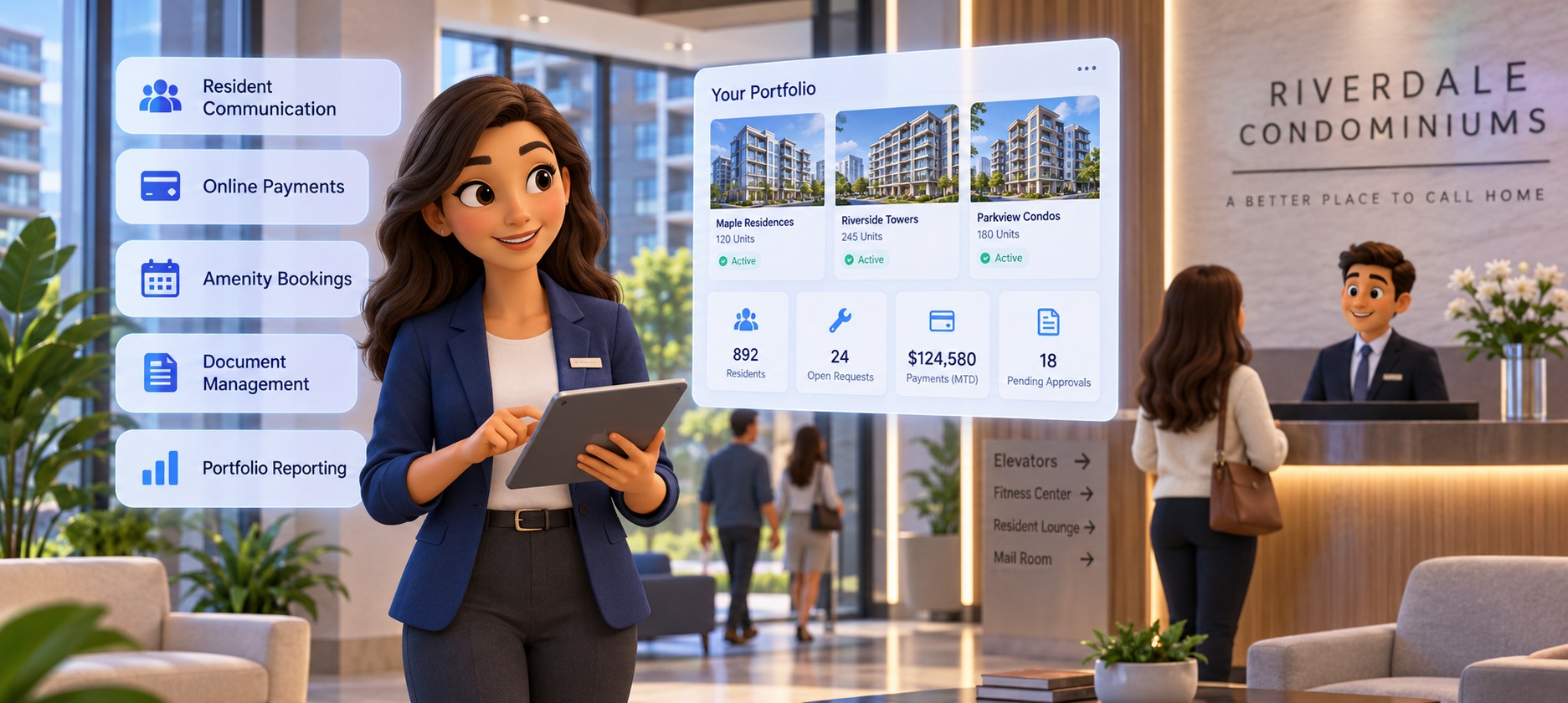
A strong condo management platform centralizes resident communication, payments, amenity bookings, and document management into one cloud-based system. It should scale across buildings, integrate with your accounting software, and include mobile access for both staff and residents. Look for security, transparent pricing, responsive support, and features designed specifically for residential community operations.

Every portfolio has different operational rhythms, resident expectations, and reporting requirements that shape your software evaluation process. Before comparing vendors, map your current workflows to identify where manual tasks slow your team down the most. A clear picture of daily pain points helps you weigh features against your actual condo management priorities.
Core capabilities worth confirming include the following areas, according to industry standards for modern platforms:
Additionally, evaluate whether the platform offers customizable dashboards and configurable modules for each building. Communities differ in size, amenities, and resident demographics, so flexibility matters more than a fixed feature set.
Ultimately, the strongest platforms combine breadth of features with the ability to toggle modules based on unique community needs. Prioritize systems that grow with your portfolio rather than forcing standardization that frustrates managers and residents alike.
Growing portfolios need infrastructure that supports new buildings without requiring separate systems, duplicate logins, or manual data transfers. According to Community Associations Institute, community associations house 77.1 million Americans across roughly 33% of the U.S. housing stock. Serving this growing population well requires condo management technology built for scale from day one.
Data security should sit at the top of your evaluation checklist, especially given how much sensitive resident information passes through modern platforms. Ask vendors about encryption practices, backup frequency, hosting infrastructure, and audit trails covering administrative actions. Reliable providers document their security posture openly, so hesitation on these questions is a meaningful signal.
Then look closely at integration depth with your accounting or property management system, whether Vantaca, QuickBooks, MDS, or Enumerate. Deep integrations reduce reconciliation work and give finance teams real-time visibility into resident payments and community balances. You can explore how these connections work through the accounting and property management partners available across leading platforms.
Also, check whether the vendor supports single sign-on, role-based permissions, and configurable access controls for boards, staff, and residents. Consequently, your team gains flexibility without sacrificing oversight or exposing sensitive information to unauthorized users.

Resident expectations have shifted dramatically as consumer apps set new benchmarks for speed, clarity, and self-service functionality. Modern condo management software should meet residents where they already are, on mobile devices and through familiar interfaces. Poor resident experience creates escalations, board complaints, and long-term dissatisfaction that erodes property value over time.
Look for platforms with built-in announcements, targeted notifications, and two-way messaging between residents and management staff. According to a property management software market analysis, North America held a 42.5% revenue share in 2024, driven by high digital adoption and integrated communication tools. Strong messaging features directly reduce phone volume and email backlogs for on-site teams.
In addition, evaluate whether the platform offers a native mobile app with feature parity between web and mobile experiences. Residents should be able to submit requests, book amenities, track packages, and receive notifications without switching apps. Learn more about modern resident engagement approaches in our post on boosting engagement with a custom resident mobile app.
Finally, consider AI-powered assistants that answer routine questions using your own building policies as the knowledge base. Automation of common inquiries frees your team to handle complex, high-value work across the portfolio.
Software selection is rarely a one-time transaction, since implementation quality often determines whether your team adopts the platform fully. Ask each vendor about their onboarding process, training resources, and dedicated customer success support model. Well-structured implementations shorten time-to-value and reduce disruption for staff, boards, and residents across every community.
Also, request references from portfolios similar to yours in size, complexity, and resident demographics. Real-world conversations often surface practical details that sales presentations tend to overlook or downplay. Meanwhile, evaluate how vendors handle product updates, feature requests, and roadmap transparency going forward.
Consider the vendor's understanding of condo management through years of residential experience and active industry association memberships. A partner grounded in this space can guide you through decisions that generic property software providers may miss. Explore how experienced providers approach these decisions through our Why Concierge Plus page and additional context on our about us overview.
For further reading on evaluating platforms, review our guide on key factors to evaluate in your next HOA management software.
Choosing the right condo management platform sets the foundation for smoother operations, stronger resident satisfaction, and confident portfolio growth. Take time to evaluate features, security, integrations, and support against your organization's specific needs and long-term goals. The right partner will help you standardize workflows while giving each community the flexibility it needs.
Concierge Plus brings more than 20 years of residential community experience, purpose-built modules, and AI-enabled tools to your portfolio. Our team works closely with property managers to design workflows that reduce manual effort and improve every resident interaction. Get in touch through our contact page to schedule a personalized walkthrough with our team.